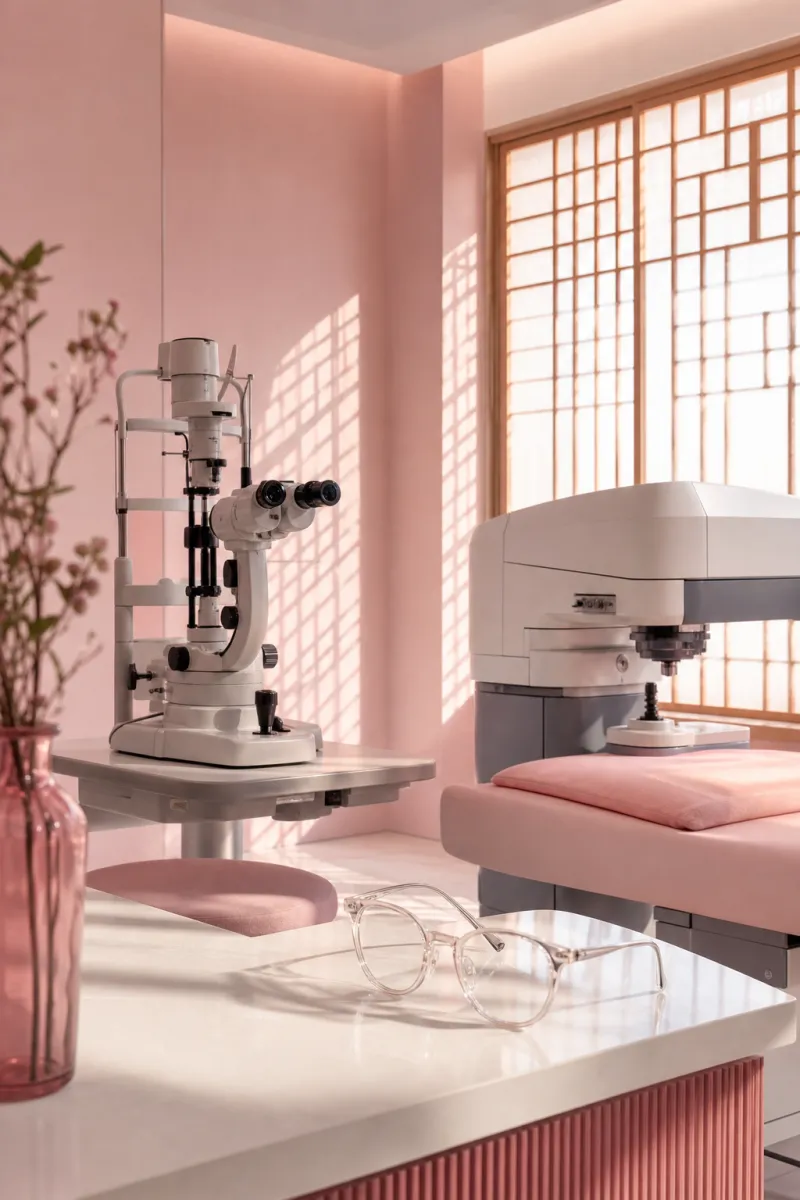
Laser eye surgery in Korea covers three corneal procedures, SMILE, LASIK and LASEK, with a lens implant (ICL) offered when the cornea is not suited to a laser. All of them are done with anesthetic eye drops while you are awake, and the laser procedures usually treat both eyes in one session. Which one you can have is decided by the clinic's examination, so build the trip around that visit and the check on the day after surgery.
Clinics in Korea
10 clinics for Vision correction in Korea
| # | Clinic | Devices & products | Area | Languages | Listed price | Google rating |
|---|---|---|---|---|---|---|
| 1 | Clear Seoul Eye Clinic | SMILE Pro · SMILE · LASIK · Presbyopia correction | Gangnam Station | English · Español · 日本語 · ไทย | ₩1,490,000 | 5.0 (328) |
| 2 | Gangnam Smile Eye Clinic | SMILE · LASIK · LASEK | Gangnam Station | English · Монгол | - | 5.0 (528) |
| 3 | St. Mary's Jin Eye Clinic | SMILE · LASEK · ICL lens implant | Gangnam Station | English · 日本語 · 中文 · Монгол | ₩990,000 | 4.9 (107) |
| 4 | Dream Eye Center | SMILE · LASEK · ICL lens implant | Gangnam Station | English | - | 5.0 (298) |
| 5 | S&B Eye Clinic | SMILE Pro · SMILE · LASIK | Apgujeong Station | English | - | 5.0 (467) |
| 6 | Samsung Miracle Eye Clinic (Gangnam) | SMILE Pro · SMILE · LASIK | Gangnam Station | English | - | 5.0 (489) |
| 7 | B&VIIT EYE CENTER | SMILE Pro · SMILE · LASIK | Korea | - | - | 4.9 (1,289) |
| 8 | Bright St. Mary's Eye Clinic (BSM, Gangnam) | SMILE · LASIK · LASEK | Gangnam Station | English · 中文 | - | 4.9 (699) |
| 9 | Gangnam Brand Eye Clinic | SMILE Pro · SMILE · LASIK | Nonhyeon Station | English · 日本語 · 中文 · Монгол | - | 4.9 (752) |
| 10 | Raum Smile Eye Clinic | SMILE · LASIK · LASEK | Yeoksam Station | English · 中文 · 日本語 · Монгол | - | - |
 1
1. Clear Seoul Eye Clinic
★ 5.0328 Google reviewsClear Seoul Eye Clinic is a 2-minute walk from Gangnam Station Exit 10, a vision clinic with a 5.0 average from 328 Google reviews. It lists vision correction on its menu. Consultations are available in English, Spanish, Japanese and Thai; listed vision correction prices start at ₩1,490,000.
Gangnam Station clinic for SMILE, cataract and presbyopia care
- SMILE & LASIK
- Cataract lenses
- Dry eye care
- The site covers SMILE Pro, Personal Eyes LASIK, same-day LASEK, ICL, cataract and glaucoma care.
- A Taiwan-facing version is linked from the language menu alongside Korean and English.
Cataract and presbyopia patients · Traditional Chinese speakers
- Location
- Gangnam Station Exit 10, 154 m (2-minute walk); Sinnonhyeon Station (Line 9 / Sinbundang Line) Exit 7, 10-minute walk
- Languages
- English · Español · 日本語 · ไทย
- Listed price
- From ₩1,490,000
2. Gangnam Smile Eye Clinic
★ 5.0528 Google reviewsGangnam Smile Eye Clinic is a vision clinic a 1-minute walk from Gangnam Station Exit 10, rated 5.0 from 528 Google reviews. Vision correction is on its menu. It consults in English and Mongolian.
Gangnam Station clinic for SMILE, LASEK and cataract care
- SMILE focus
- One-stop care
- Two floors
- The site describes one-stop care covering vision correction, presbyopia, cataract, glaucoma and oculoplastic treatment.
- It closes on Wednesdays, Sundays and public holidays, and lists a Mongolian-language direct line.
Cataract and presbyopia care · SMILE and LASEK candidates
- Location
- Line 2 Gangnam Station Exit 10, 1-minute walk
- Languages
- English · Монгол
3. St. Mary's Jin Eye Clinic
★ 4.9107 Google reviewsSt. Mary's Jin Eye Clinic sits a 5-minute walk from Gangnam Station Exit 5, a vision clinic that holds a 4.9 Google rating across 107 reviews. It lists vision correction on its menu. It consults in English, Japanese, Chinese and Mongolian, and its listed vision correction price starts from ₩990,000.
Gangnam eye clinic for cataract, SMILE and ICL surgery
- Cataract & retina
- English-speaking clinic
- Gangnam Station
- The clinic recommends about one week in Seoul for cataract surgery.
- Care covers vision correction, cataract and presbyopia surgery, glaucoma screening, retina care and paediatric myopia control.
High myopia ICL candidates · Cataract surgery travellers
- Location
- Gangnam Station Exit 5, 5-minute walk
- Languages
- English · 日本語 · 中文 · Монгол
- Listed price
- From ₩990,000
4. Dream Eye Center
★ 5.0298 Google reviewsDream Eye Center runs a vision clinic by Gangnam Station Exit 1; its Google rating is 5.0 from 298 reviews. Vision correction is on its menu. Consultations are available in English.
Gangnam Station eye clinic for SMILE, LASEK and ICL
- Vision correction
- English-speaking staff
- 14th-floor clinic
- The clinic has offered vision correction, presbyopia and cataract surgery and general eye exams since 2000.
- Its English site says English-speaking ophthalmologists and a global care team assist international patients.
High myopia consultations · English-language care
- Location
- Gangnam Station Exit 1 (Line 2 / Shinbundang Line)
- Languages
- English
5. S&B Eye Clinic
★ 5.0467 Google reviewsS&B Eye Clinic is by Apgujeong Station Exit 3, a vision clinic with a 5.0 average from 467 Google reviews. It lists vision correction on its menu. It consults in English.
Apgujeong eye clinic for SMILE Pro, LASEK and ICL
- Vision correction
- Open surgical suite
- Apgujeong Station
- Its English site lists SMILE Pro, SMILE LASIK, LASIK, LASEK, ICL and presbyopia cataract surgery.
- The clinic opened in 2007 and describes a 74-point diagnostic examination.
Early presbyopia (monovision) · Friday evening visits
- Location
- Apgujeong Station Exit 3, about 50 m toward the Andaz hotel
- Languages
- English
6. Samsung Miracle Eye Clinic (Gangnam)
★ 5.0489 Google reviewsSamsung Miracle Eye Clinic (Gangnam) is a vision clinic by Gangnam Station Exit 12, rated 5.0 from 489 Google reviews. Vision correction is on its menu. It consults in English.
Gangnam Station clinic for SMILE Pro, ICL and cataract
- SMILE & ICL
- Single-day pathway
- Two floors
- ICL is presented for thin corneas and high prescriptions, alongside SMILE Pro, LASIK and cataract surgery.
- The English site offers consultation, examination and surgery in a single day for international patients.
English-speaking patients · Thin corneas or high prescriptions
- Location
- Gangnam Station (Line 2 & Sinbundang Line) Exit 12
- Languages
- English
 7
7. B&VIIT EYE CENTER
★ 4.91,289 Google reviewsB&VIIT EYE CENTER sits in Korea, a vision clinic that holds a 4.9 Google rating across 1,289 reviews. It lists vision correction on its menu.
Gangnam Station centre for SMILE, ICL and cataract surgery
- Established 1994
- AI-assisted planning
- Same-day option
- Established in 1994, the centre performs SMILE Pro, SMILE, LASIK, LASEK, ICL and cataract surgery.
- An English-speaking coordinator supports international patients, and the site lists four foreign languages.
Thin corneas (LASEK) · English, Japanese, Chinese speakers
- Location
- Korea
8. Bright St. Mary's Eye Clinic (BSM, Gangnam)
★ 4.9699 Google reviewsBright St. Mary's Eye Clinic (BSM, Gangnam) runs a vision clinic a 1-minute walk from Gangnam Station Exit 1; its Google rating is 4.9 from 699 reviews. Vision correction is on its menu. It consults in English and Chinese.
Gangnam Station eye clinic for SMILE, LASEK and ICL
- SMILE & LASEK
- Multi-floor clinic
- Late Fridays
- Listed procedures include Smart Nova Pro, Silk SMILE, 2-DAY LASEK and lens implants.
- The clinic describes itself as an early provider of LASIK and LASEK in Korea.
Lens implant candidates
- Location
- Gangnam Station Exit 1, 1-minute walk
- Languages
- English · 中文
9. Gangnam Brand Eye Clinic
★ 4.9752 Google reviewsGangnam Brand Eye Clinic is by Nonhyeon Station Exit 4, a vision clinic with a 4.9 average from 752 Google reviews. It lists vision correction on its menu. Consultations are available in English, Japanese, Chinese and Mongolian.
Gangnam eye clinic for SMILE, cataract and presbyopia surgery
- SMILE & cataract
- Retina & glaucoma
- Three-floor clinic
- The clinic names SCHWIND ATOS for SMILE and LENSAR for cataract and presbyopia surgery.
- Its Korean site covers SMILE, same-day LASEK, lens implantation, cataract, retina and glaucoma care.
Retina or glaucoma checks
- Location
- Line 7 Nonhyeon Station (Exit 4 direction); Line 9 Sinnonhyeon Station (Exit 2 direction)
- Languages
- English · 日本語 · 中文 · Монгол
 10
10. Raum Smile Eye Clinic
Raum Smile Eye Clinic is a vision clinic a 3-minute walk from Yeoksam Station Exit 3. Vision correction is on its menu. Consultations are available in English, Chinese, Japanese and Mongolian.
Gangnam eye clinic for SMILE, cataract and retina care
- SMILE & LASEK
- Three floors
- Five-language site
- Clinics listed include SMILE, vision correction, presbyopia and cataract, retina and glaucoma, and dry eye.
- The site is offered in Korean, Traditional Chinese, English, Japanese and Mongolian.
SMILE consultations · Traditional Chinese or Japanese speakers
- Location
- Yeoksam Station (Line 2) Exit 3, about 3 min walk; Gangnam Station (Line 2) Exit 1, about 5 min walk
- Languages
- English · 中文 · 日本語 · Монгол
Prices
Vision correction cost in Korea
Prices below come from the listed clinics' own price lists. Vision-correction and cataract surgery are VAT-exempt medical care in Korea, so the listed price is the price you pay.
All-laser LASEK (SCHWIND AMARIS), both eyes
Price at 1 listed clinic · approx. $720₩990,000Compare clinicsPremium Today LASEK
Price at 1 listed clinic · approx. $1,084₩1,490,000Compare clinicsCataract surgery, monofocal lens (Clareon), per eye
Price at 1 listed clinic · approx. $1,091From ₩1,500,000Compare clinicsPremium One-day LASIK
Price at 1 listed clinic · approx. $1,520₩2,090,000Compare clinicsPresbyopia LASIK / LASEK
Price at 1 listed clinic · approx. $1,593₩2,190,000Compare clinicsZEISS SMILE
Price at 1 listed clinic · approx. $1,818₩2,500,000Compare clinicsCataract surgery, premium multifocal / EDOF lens, per eye
Price at 1 listed clinic · approx. $2,182₩3,000,000Compare clinicsSILK SMILE (ELITA), both eyes
Price at 1 listed clinic · approx. $2,545₩3,500,000Compare clinicsGuide
SMILE, LASIK, LASEK and ICL Side by Side
The three laser procedures all change the shape of the cornea, but they reach the tissue in different ways. LASIK creates a thin flap, lifts it, reshapes the layer underneath with an excimer laser and lays the flap back. LASEK, which Korean clinics often use as the umbrella name for surface methods including PRK, moves the thin outer layer aside and applies the laser to the surface, so no flap is cut. SMILE uses a femtosecond laser to cut a small disc of tissue inside the cornea, and the surgeon removes it through a small incision.
ICL is not a laser procedure at all. A thin artificial lens is placed inside the eye, behind the iris and in front of the natural lens, and no corneal tissue is removed. It is often considered for moderate to high myopia, or for corneas that are too thin for a laser.
None of the four is the right answer in general; your scan results decide which are open to you. Flap and surface methods have long been compared: Shortt and colleagues reviewed LASIK versus PRK for myopia in the Cochrane Database of Systematic Reviews in 2013.
| Procedure | What is done | Early recovery | Often considered when |
|---|---|---|---|
| SMILE | A disc of tissue is cut inside the cornea and removed through a small incision; no flap | Usually functional within the first days; clarity may keep improving for weeks | Stable myopia, with or without astigmatism, and a thick, regular cornea |
| LASIK | A flap is created, the tissue underneath is reshaped, the flap is laid back | Generally the fastest of the corneal procedures, though it varies by person | Stable prescription, adequate corneal thickness, low risk of a blow to the eye |
| LASEK / PRK | The outer layer is moved aside, the surface is reshaped, a bandage lens is placed | Several days of discomfort and blur; vision settles over weeks to a few months | Thinner corneas, contact sports or work with a risk of eye injury |
| ICL | A lens is placed inside the eye; no corneal tissue is removed | Often quick, though it varies; eye pressure is checked the same day | Moderate to high myopia, or a cornea not suited to laser correction |
Guide
What the Examination Before Surgery Decides
Suitability is settled at the clinic, after a full set of measurements: refraction, corneal thickness, a map of the corneal shape, pupil size, tear film, eye pressure and a look at the retina through dilated pupils. An ICL assessment adds the depth of the space at the front of the eye and a count of the cells lining the inner cornea.
The corneal map matters most. It exists to find eyes with a tendency toward ectasia, a progressive weakening and bulging of the cornea. A clinic that declines to operate, or suggests a different procedure after these scans, is acting on that evidence.
The visit takes a few hours, varying by clinic. Dilating drops blur near vision and make light uncomfortable for several hours, so keep the rest of that day free of screens, reading and driving. Some clinics operate on the same day for people who qualify, but a visitor may also be found unsuitable, so leave room for that outcome.
- Your current glasses and any earlier prescriptions
- A list of the medicines you take
- Records of any previous eye surgery
Guide
Trip Planning: Contact Lenses, Length of Stay, Flight Home
Contact lenses change the shape of the cornea, so they have to be left out before the measurements. How long depends on the lens type and on the clinic. Soft lenses need the shortest break, toric soft lenses and rigid gas-permeable lenses need longer, and overnight reshaping (orthokeratology) lenses need the longest. Confirm the period with the clinic before you book flights.
No single length of stay applies to everyone. As a pattern, LASIK and SMILE allow the shortest visits, since early recovery is quick and the first check is the day after surgery. LASEK needs longer, because the clinic removes the bandage contact lens only once the surface has healed. ICL visitors should allow for early checks of eye pressure and lens position, and should ask about lead time, since a lens made to order may not be in stock.
Cabin pressure does not harm an eye after these procedures, because no gas is left inside it. The practical limit on flying is the timing of the post-operative checks, and the surgeon decides when you may travel. Cabin air is dry, so carry lubricating and prescribed drops in hand luggage.
Guide
Side Effects and Limits Shared by Every Procedure
Dry eye is the most common side effect after LASIK and also occurs after SMILE and surface treatment. It usually improves over months but can persist. Glare, halos and starbursts around lights at night can appear as well. How patients themselves describe life after LASIK was the subject of the PROWL studies, published by Eydelman and colleagues in JAMA Ophthalmology in 2017, which looked at both symptoms and satisfaction.
The correction can land slightly under or over the target, and a second procedure is possible only if enough corneal tissue remains. Ectasia is rare but serious and has been reported after every type of corneal laser surgery; screening lowers the risk without removing it. Infection is rare but possible. With ICL the concerns differ: raised eye pressure early on, clouding of the natural lens and gradual loss of corneal lining cells, which is why long-term checks continue.
Some things no surgeon can promise:
- A specific level of vision, or a life without glasses
- That dry eye or night-vision symptoms will not occur or will fully clear
- That a second procedure will be possible if the first falls short
- That reading glasses will not be needed later
Guide
Aftercare Once You Are Back Home
A check the day after surgery is standard, and it usually happens before you leave Korea. The later checks, spread over the following weeks and months, are the part a visitor has to arrange. Find an eye doctor at home who is willing to follow you.
Before departure, ask for a written surgical record: the treatment data for a laser procedure, or the lens model and power for an ICL. Collect the full course of eye drops with written instructions, because the drops continue after you land. Ask how the clinic handles an enhancement or a complication for someone who lives abroad; policies differ.
Early on, do not rub your eyes, wear the night shields and sunglasses as instructed, and avoid pools, saunas and eye make-up for as long as the clinic sets. After LASEK, steroid drops often continue for longer, which is one more reason not to skip follow-up visits.
Guide
Cataract and Reading-Vision Surgery, and Where to Read Next
A cataract is a clouding of the eye's natural lens, and surgery replaces that lens with an artificial one. A monofocal lens gives one focal distance, usually far, so reading glasses are normally still needed. Multifocal and extended-depth-of-focus lenses reduce dependence on glasses but bring more glare and halos.
Presbyopia, the age-related loss of near focus that most people notice from their mid-40s, has no procedure that restores a young lens; every option is a compromise between distances. If you have had LASIK, LASEK or SMILE, keep the records, because lens calculations for later cataract surgery are less predictable in treated eyes.
Readers searching for laser eye surgery cost in Korea, or eye surgery Korea cost more broadly, will find listed prices in the table on this page and the reasoning behind a quote on the price page.
Guides
Guides on this site
Evidence
Research behind this page
- Symptoms and Satisfaction of Patients in the Patient-Reported Outcomes With Laser In Situ Keratomileusis (PROWL) StudiesJAMA Ophthalmology · 2017 · doi:10.1001/jamaophthalmol.2016.4587
The PROWL studies examined the symptoms and the satisfaction that patients themselves reported after LASIK.
- Laser-assisted in-situ keratomileusis (LASIK) versus photorefractive keratectomy (PRK) for myopiaCochrane Database of Systematic Reviews · 2013 · doi:10.1002/14651858.cd005135.pub3
A Cochrane systematic review comparing LASIK with PRK for myopia.
FAQ
Questions about Vision correction in Korea
Which clinics offer Vision correction in Korea?
Clinics offering Vision correction in Korea include Clear Seoul Eye Clinic (Gangnam Station), Gangnam Smile Eye Clinic (Gangnam Station), St. Mary's Jin Eye Clinic (Gangnam Station), Dream Eye Center (Gangnam Station) and S&B Eye Clinic (Apgujeong Station). Each lists Vision correction on its own menu; message the clinic directly to confirm the doctor, product and current price.
Who can have laser eye surgery in South Korea as a visitor?
Adults with a stable prescription and corneas of adequate thickness and regular shape are the usual candidates, but only the examination confirms it. Surgery is normally postponed during pregnancy and breastfeeding, and in eyes with active infection, inflammation or uncontrolled dry eye. A prescription that is still changing is another reason to wait. A visitor also needs time for the scans, the operation and the first check before flying.
How long before the trip should I stop wearing contact lenses?
The break depends on your lens type and on the clinic, so ask the clinic for its own figure before booking. Soft lenses need the shortest pause, toric soft and rigid gas-permeable lenses need more, and overnight orthokeratology lenses need the most. The reason is that lenses mould the corneal surface, and the laser plan is built on those measurements.
How many days should I stay for Korea laser eye surgery?
There is no fixed number, because the stay depends on the procedure, the clinic's schedule and how your eyes heal. LASIK and SMILE generally allow the shortest trips, LASEK takes longer because the bandage lens is removed by the clinic after the surface closes, and ICL needs early checks of pressure and lens position. Ask the clinic for its timetable in writing, then add spare days in case the examination changes the plan.
When is it fine to fly home after South Korea laser eye surgery?
Your surgeon decides after the post-operative examination, and no universal number of days applies to every patient. Air pressure in the cabin is not the issue, since these procedures leave no gas in the eye. What limits travel is the check schedule and, after LASEK, removal of the bandage contact lens. On board, the air is dry, so use lubricating drops often and keep all prescribed drops in your carry-on bag.
Does the surgery hurt?
Anesthetic drops numb the eye during the operation, so most of the sensation is pressure rather than sharp pain. What follows depends on the method. After LASIK, discomfort is typically mild and short-lived. After LASEK or PRK, pain, watering, light sensitivity and blurred vision are expected for several days while the surface heals. Ask the clinic which drops to use for comfort.
What happens if the clinic says my eyes are not suitable?
The clinic will either propose a different procedure or advise against surgery, and both outcomes are part of normal screening. A cornea too thin for LASIK may still suit a surface method, and an eye outside laser limits may be assessed for ICL instead, which has its own measurements to pass. Because this can change the timetable and the budget, avoid non-refundable plans built on one specific operation.
Is ICL a kind of laser eye surgery?
No, ICL is a lens implant placed inside the eye, and the cornea is not reshaped by a laser. It appears next to laser options because it corrects the same problem and is often the alternative when the cornea rules a laser out. It is surgery inside the eye, so eye pressure is checked the same day and periodic checks continue long term. The lens can be removed or exchanged by another operation.
Can both eyes be treated on the same day?
Yes for the laser procedures: SMILE, LASIK and LASEK usually treat both eyes in a single session under anesthetic drops. ICL is different, because some clinics implant both lenses on one day and others separate the eyes, and cataract surgery is done one eye at a time in most clinics. Ask which pattern the clinic follows before fixing dates, since separate days lengthen the stay.